
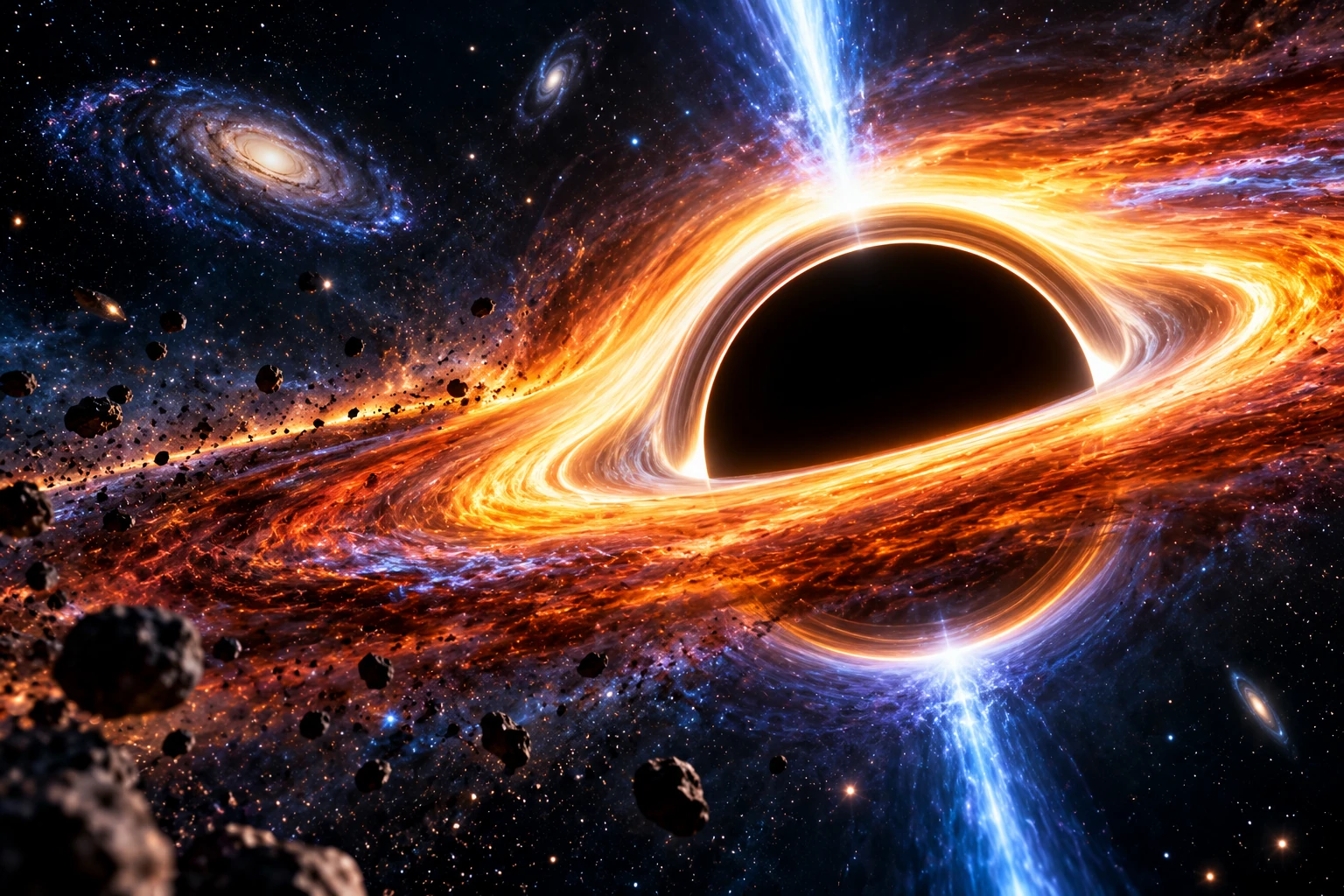
Black holes are among the most fascinating objects in the universe. Their gravity is so powerful that beyond a particular boundary, not even light can escape. Although scientists have learned a great deal about them through mathematics, telescopes, and gravitational-wave observations, black holes still challenge our understanding of space and time.
From their ability to distort light to their connection with some of the universe’s most energetic events, here are ten remarkable facts about black holes.
1. Black Holes Can Bend Light
Gravity affects the path of light. Because black holes concentrate enormous amounts of mass into a relatively small region, they can bend light passing nearby.
This phenomenon is known as gravitational lensing. Light from objects behind a black hole may appear distorted, stretched, or arranged into unusual patterns. In some circumstances, the black hole’s gravity can create multiple images of the same distant object.
Scientists use these effects to study the environments around black holes and understand how gravity influences the appearance of the universe.
2. Time Passes Differently Near a Black Hole
According to Einstein’s theory of general relativity, gravity affects the passage of time. A clock positioned in a stronger gravitational field runs more slowly relative to a clock far away, assuming other relevant conditions are controlled.
Near a black hole, this effect can become extreme. To a distant observer, processes near the event horizon may appear increasingly slowed and their light increasingly redshifted.
However, someone falling through the event horizon of a sufficiently large black hole would not necessarily notice anything unusual at that exact moment.
3. Black Holes Are Not Cosmic Vacuum Cleaners
Despite their reputation, black holes do not automatically pull everything around them into their centers.
At a sufficient distance, a black hole’s gravitational influence behaves much like that of any other object with the same mass. If the Sun were hypothetically replaced by a black hole of equal mass, Earth’s orbit would remain approximately the same, although Earth would lose the sunlight needed to sustain life.
Objects must approach sufficiently closely or lose enough orbital energy to fall into a black hole.
4. Some Black Holes Are Millions or Billions of Times More Massive Than the Sun
Black holes come in different sizes. Stellar-mass black holes form through processes involving massive stars, while supermassive black holes occupy the centers of many galaxies.
Some supermassive black holes contain millions or billions of solar masses. The black hole at the center of our Milky Way, Sagittarius A*, has a mass of approximately four million Suns.
How the earliest supermassive black holes grew so quickly in the young universe remains an important research question.
5. Black Holes Can Produce Powerful Jets
Some black holes are surrounded by hot, rotating disks of gas and dust called accretion disks. Magnetic fields and complex plasma processes can help launch powerful jets of material from the regions near these black holes.
The jets may extend for enormous distances across space and travel at speeds approaching that of light.
Importantly, the material in these jets is not simply escaping from inside the event horizon. The jets originate from the surrounding environment, where matter and magnetic fields interact with the black hole’s gravity and rotation.
6. Black Holes Can Collide and Merge
When two black holes orbit one another, they can gradually lose orbital energy by producing gravitational waves.
Eventually, they may merge into a single, larger black hole. This event releases energy through ripples in spacetime that can be detected by specialized observatories on Earth.
Scientists first directly detected gravitational waves from a black hole merger in 2015. These observations opened a new way of studying the universe beyond conventional light-based astronomy.
7. Black Holes Can Slowly Lose Energy
Theoretical physicist Stephen Hawking proposed that quantum effects near a black hole’s event horizon cause it to emit what is now called Hawking radiation.
As a result, a black hole can gradually lose mass and energy. For ordinary astrophysical black holes, this process is extraordinarily slow, and the predicted radiation has not yet been directly detected from an actual black hole.
Very small hypothetical black holes would evaporate much more quickly than massive ones.
8. The Event Horizon Is Not a Solid Surface
The event horizon is a boundary beyond which signals cannot escape to distant observers. It is not a physical shell or solid wall.
An astronaut falling into a sufficiently large black hole might cross the event horizon without encountering a solid surface or necessarily noticing a sudden local change.
What happens deeper inside is much harder to establish because our current theories are incomplete when quantum effects and extreme gravitational conditions become important.
9. Some Black Holes Are Surprisingly Quiet
Not every black hole produces bright jets or a glowing accretion disk.
A black hole with little nearby material to consume may be difficult to detect directly. Astronomers can sometimes identify such objects by observing their gravitational effects on nearby stars or other matter.
This means the universe could contain many black holes that are not obvious in ordinary telescope images.
10. Black Holes Challenge Our Understanding of Physics
Black holes bring together some of the most difficult questions in modern physics. General relativity describes gravity and spacetime on large scales, while quantum mechanics describes matter and energy at microscopic scales.
Near the deepest regions of a black hole, scientists expect that a more complete theory combining these ideas will be necessary.
Questions about information, singularities, and the ultimate fate of matter remain central topics in theoretical research.
Conclusion
Black holes are not merely mysterious objects that consume everything nearby. They are powerful laboratories for understanding gravity, time, energy, and the evolution of galaxies.
Observations of black hole shadows, stellar orbits, gravitational waves, and energetic jets have already transformed astronomy. Future discoveries may answer some of the biggest remaining questions about these extraordinary objects and the fundamental laws governing our universe.